
Some trees do not need to go, they just need a haircut. A branch scraping the roof, limbs hanging over the driveway, a canopy that has swallowed the fence line: these are pruning jobs, not removal jobs. But the way a tree is cut back makes a big difference to how it looks, how healthy it stays and how much mess is left on your lawn.
This guide is for anyone searching for tree loppers in Perth. It explains what lopping and pruning actually mean, how crews deal with awkward branches, and how to choose one who will do the job properly and leave the place tidy.
What Tree Loppers Do and How the Job Differs from Removal
For branches that are hard to reach, many homeowners look for the Perth crew locals trust to lop and prune awkward branches without the mess. It helps to know what you are actually asking for, because the terms get used loosely and the results are very different.
Tree removal takes the whole tree out. Lopping and pruning work on the tree while it stays where it is, removing selected branches to solve a specific problem, such as clearance, safety or shape. The goal is to fix the problem while keeping the tree healthy and stable, which takes more judgement than simply cutting things off.
Lopping, Pruning and Topping: What Is the Difference?
People use these words interchangeably, but arborists do not.
Pruning: Selective removal of particular branches, cut back to a suitable branch or junction, to improve structure, safety or clearance while keeping the tree healthy.
Lopping: A general term for cutting branches, often used loosely. Done well, it is just pruning. Done badly, it means chopping limbs off at random points along their length.
Topping: Cutting the main stems of a tree back to stubs or to a set height. It is widely discouraged, because it leaves large wounds that trees struggle to seal and often triggers dense, weakly attached regrowth.
The Australian Standard for pruning amenity trees, AS 4373, sets out accepted pruning practice, and many councils and arborists refer to it. A crew that follows good practice will talk about cutting back to a branch union, taking off only what the tree can cope with, and leaving clean cuts. A crew that offers to take the top off so the tree stays small is offering the opposite.
Awkward Branches and How Crews Reach Them
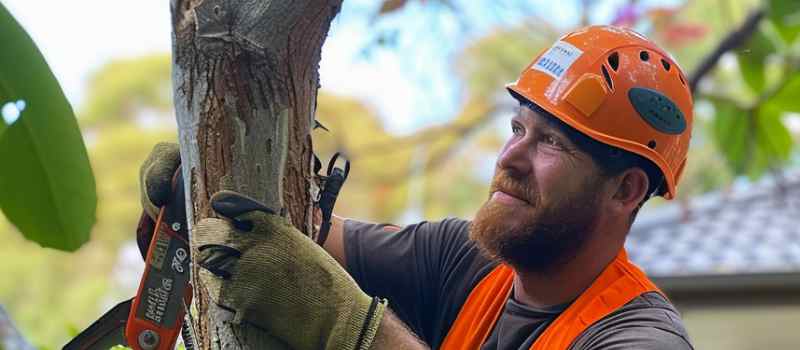
Most pruning jobs people struggle with are awkward for a reason. The branch hangs over the roof, leans across a fence, crowds a driveway or sits close to power lines, and a ladder and pole saw are not a safe answer.
Professionals have several ways to deal with this. Climbers use ropes and harnesses to reach the branch from inside the tree. Elevated platforms can lift a worker to the right height without climbing. Pole saws handle light work from the ground. For branches over roofs, fences or garden beds, the crew will usually cut the branch in sections and lower each piece on a rope so nothing lands on what it is meant to avoid.
Work near power lines is a special case that should only be done by suitably authorised people. Do not try to prune anything that touches or leans on a line, and ask any crew how they manage it.
When to Prune in Perth
There is no single best month for every tree. The right timing depends on the species, its condition and what you are trying to achieve, so ask the arborist rather than following a rule of thumb. As a general principle, avoid heavy pruning when a tree is already stressed, such as during a long hot dry spell, because every cut is a wound the tree has to pay for with stored energy. Dead or dangerous branches are the exception and should be dealt with promptly.
Overhanging Branches and the Neighbours
Branches that cross a boundary are a common source of friction. The general position, as the Citizens Advice Bureau of WA explains in its guide to encroaching roots and branches, is that you can cut branches that overhang your land back to the boundary, but not beyond it, and anything you cut on your neighbour’s side of the line can leave you liable for damage. Cut material also belongs to the tree’s owner.
That is general information, not legal advice, and two extra points apply. Some trees are regulated by local councils, which can mean approval is needed even for pruning, so check with yours. And a quick conversation with the neighbour before anyone starts cutting usually prevents most disputes. If the branches are high or awkward, it is often simplest to agree that a professional crew will do the work.
A Simple Checklist for Choosing a Crew
When you compare quotes, look for the following:
- Insurance: A current certificate covering the crew and your property.
- Qualifications and experience: Ask about arboriculture training. A Certificate III in Arboriculture is a benchmark some councils use, and the person running the job should be able to explain their approach.
- A written quote: It should describe the work, such as which branches, how much is coming off and what is included.
- Method: Ask how they will reach the branches and protect the roof, fence and garden.
- Clean-up: Confirm that branches are cleared, debris is removed and the site is left tidy.
- Communication: A good crew explains what they recommend, and why, rather than simply agreeing to whatever you ask for.
What Clean Pruning and a Tidy Site Look Like
You can judge a job by the tree and by the ground. On the tree, cuts should be made back to a branch junction rather than mid-limb, wounds should be neat, and the shape should still look like the tree, only lighter or better clear of the roof. On the ground, cut branches should be gathered up, small debris cleared away, and paths, lawn and garden beds left as they were found. Agree in advance whether branches go with the crew or stay for you to use as mulch or firewood.
Red Flags to Watch For
- Door-knockers who claim to have spotted a problem with your tree and want to start straight away.
- A crew that offers to top the tree or cut it back hard to keep it small.
- Cash-only quotes with nothing in writing.
- No insurance, or reluctance to show it.
- A price far below the others, with no mention of clean-up.
- No interest in how the tree looks, how it is growing or what you actually want to achieve.
Frequently Asked Questions
Is lopping bad for trees?
Correct pruning is fine and often beneficial. Hacking limbs off at random points, and especially topping, is what causes harm, because it leaves large wounds and weakly attached regrowth.
How much can be pruned off a tree at once?
It depends on the species, age and condition of the tree. Guidance drawn from AS 4373 is often summarised as avoiding the removal of more than around a quarter of the foliage in one season, but an arborist can advise on the right amount for your tree.
Can I cut branches that hang over from next door?
In general you can cut overhanging branches back to the boundary, but not beyond it, and you should check for any council rules that protect the tree. Talking to your neighbour first is the easiest way to avoid a dispute.
How often should trees be pruned?
There is no fixed schedule. Established trees often need less pruning than people expect, and the right interval depends on the species, how fast it grows and why you are pruning. An arborist can suggest a sensible plan.
Final Thoughts
The best pruning job is one you barely notice. The tree looks healthier, the branch is no longer a problem and the yard looks as though nobody was ever there. Learn the difference between pruning and topping, ask about insurance and method, and choose a crew that treats a clean finish as part of the work.